English · 简体中文





Composable memory for DeepSeek Harness.
Three tiers by default · Your Sources and Strategies · One View per turn
Get started · Watch the v0.5.2 demo · Build a plugin · Documentation
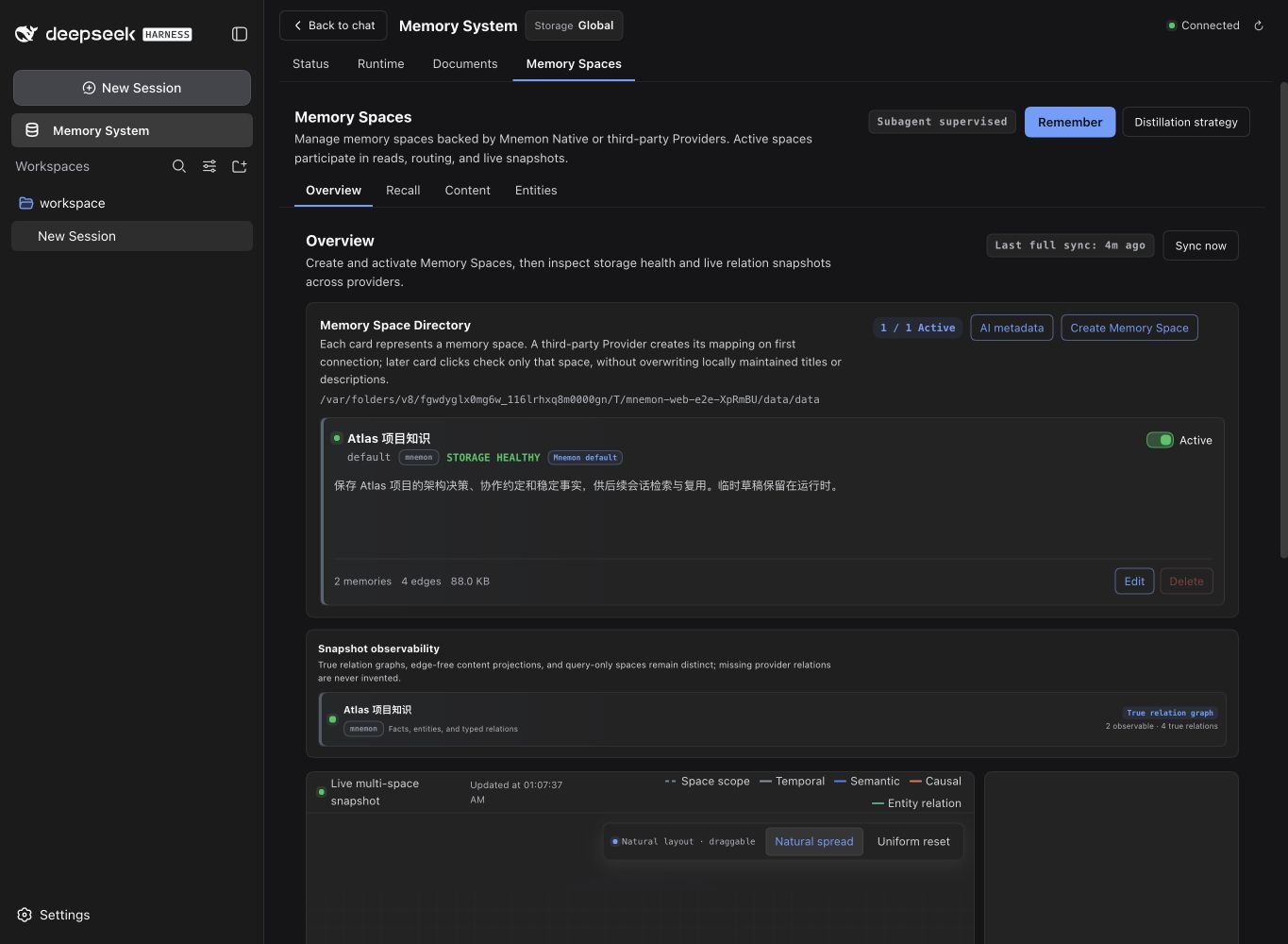
Runtime context, searchable documents and long-term evidence share a familiar Sidebar. The default Starter installs a tested plugin combination; contributors can replace or extend its parts without rebuilding the memory system.
| Memory | Keep here | How it reaches the Agent |
|---|---|---|
| Runtime | Preferences, working agreements, facts needed on the next turn | Compact USER / MEMORY projection |
| Documents | Designs, investigations, procedures and handoffs | Search, then read the relevant narrative |
| Memory Spaces | Durable facts, decisions, entities and relationships | On-demand evidence from enabled backends |
A memory space is one named, Provider-backed scope for long-term evidence. It contains individual memories and can be activated independently. The Chinese product term is 记忆空间.
Use the same data from Sidebar, conversation tools or Headless. Global, workspace and custom storage scopes are explicit. Direct retrieval does not spawn a Mnemon task Agent; Agent Query, semantic writes and maintenance may use the configured model. Workflows and costs.
You need a compatible DSH Host. Mnemon Native also needs a separately installed mnemon CLI; installing the npm Starter does not install that binary or third-party backend services. Follow the platform installation guide and verified compatibility baselines.
mnemon --version
dsh plugin --profile web add dsh-mnemon
dsh web
For Headless, add the same package to that profile with dsh plugin --profile headless add dsh-mnemon.
Open Memory System → Status, then add a Runtime memory. Select a DSH workspace before creating Documents, even with global storage. To retain long-term facts, create a Memory Space with an explicitly selected Provider. Sidebar is the default; optional Builtin placement uses the same pages.
Upgrading from v0.4 retains the familiar configuration, data and workflow. Three optional enhancements are exposed in Settings → Memory System; no View tab or generic memory-plugin manager is added. Upgrade checklist.
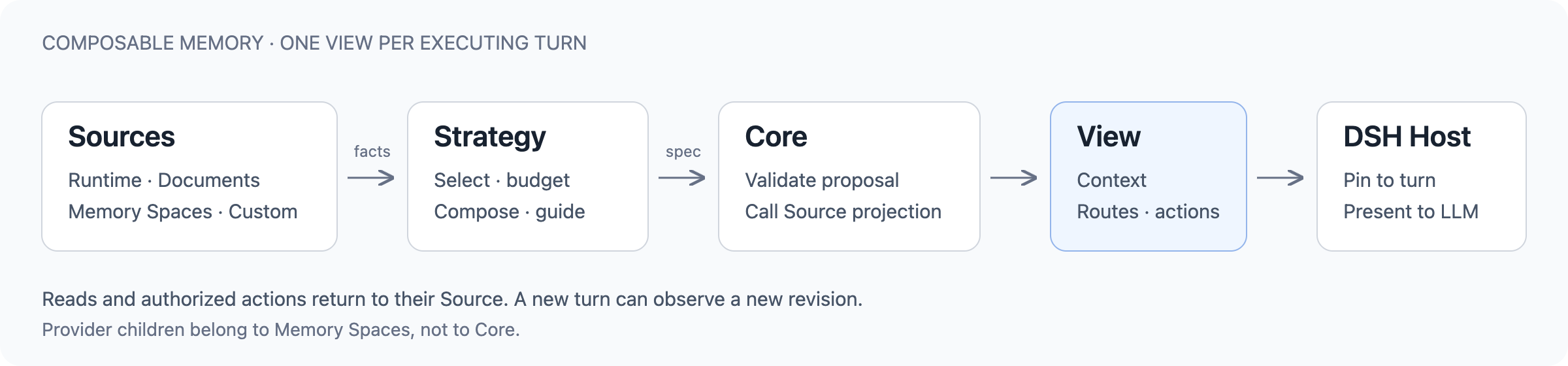
- Source owns memory, its projection, read/write operations and optional DSH pages.
- Strategy chooses how available Sources participate: selection, resident context, retrieval and guidance. Pure composition does not write memory.
- Core validates the proposal, asks Sources for bounded projections and compiles an immutable View. The DSH Host pins it to the executing turn and controls tool access.
A View includes context and the scoped routes/actions the LLM can use next. It is not another database or a frontend page. Memory Spaces owns its Provider child Fibers; Core exposes only the small ctx.mnemonMemory contribution service.
The same public contracts serve the default plugins and external repositories. Source authors keep their data and backend choices; Strategy authors reuse those capabilities, the turn lifecycle, budgets and test fixtures. Architecture and sequence diagrams.
The Starter ships 3 Sources, 1 default Strategy, 3 optional Strategy contributions and 9 Providers. Packages are independently versioned and published; the Starter pins an exact tested combination.
| Package | Responsibility | Default |
|---|---|---|
| dsh-mnemon-source-runtime | USER / MEMORY, revisions and local hot storage | Enabled |
| dsh-mnemon-source-documents | Markdown, search, revisions and archiving | Enabled |
| dsh-mnemon-source-memory-spaces | Durable evidence and Source-owned Provider children | Enabled |
| dsh-mnemon-strategy-default-three-tier | The familiar three-tier View and turn retrieval policy | Selected |
| dsh-mnemon-strategy-auto-capture | In-turn guidance to retain useful facts | Off |
| dsh-mnemon-strategy-light-context | A shared resident-projection ceiling | Off |
| dsh-mnemon-strategy-scoped | Ordered Source selection and a writable subset | Off |
The three enhancements occupy different slots of the default Strategy and can coexist. They still produce one View. Capture is guidance, not an autonomous recorder; a projection ceiling is not token accounting or delta injection; scoped selection does not create storage.
Memory Spaces can use these Provider plugins:
Mnemon Native · OpenViking · Honcho · Mem0 · Hindsight · Holographic · RetainDB · ByteRover · Supermemory.
Native is the default backend; third-party services are disabled until explicitly configured. Graph, deletion, exact-write and enumeration capabilities remain backend-specific. Provider capabilities and setup.
Use dsh-mnemon/extension-sdk to define and install a Source or Strategy on its Cordis Fiber. Use the owning Strategy's SDK for an additive contribution, or dsh-mnemon-source-memory-spaces/provider-sdk for a Memory Spaces driver.
Your repository owns its manifest, public dependencies, implementation, tests and build. DSH's Profile/Loader installs and mounts it; Mnemon does not scan arbitrary installed plugins. Installing code, activating a contribution and choosing the complete Strategy are distinct decisions.
Start with the plugin author guide and external consumer examples. They cover isolated package consumption, multiple instances, disposal, scoped reads and authorized writes. A Git or Notion integration can be a new Source; it is not implied support for every existing DSH memory plugin.
Independent plugin repositories are welcome. Contributions to this repository follow CONTRIBUTING; discuss new capabilities and Providers in an Issue first.
- Runtime and Documents are local; Native is local by default. External Providers use their configured services and scopes.
- Disabling participation does not erase memory. Switching storage scope does not migrate it. Provider disabling may clear local catalog metadata, not remote data.
- Saved Provider credentials stay on the Host and are excluded from Mnemon Packs. Packs still contain private memory and need protection.
- Source and Strategy plugins are trusted in-process JavaScript, not sandboxed code. Historical memory never outranks current instructions. Model-generated plugins are not automatically installed.
Backup and recovery · Security policy · Release history · Roadmap
pnpm install --frozen-lockfile
pnpm verify
pnpm verify:plugins
Use Node.js ^22.19.0 || >=24.0.0 and pnpm 10.13.1. Package-level checks run independently; WebUI captures use disposable data and a real DSH Host. Tests of mechanics are not claims of LLM accuracy or live cloud-Provider conformance. Development · Media provenance.