
One endpoint. More free AI than any single provider. Less rate limit headaches.
Don't want to pay $$/month to use AI Models? RelayFreeLLM is an open-source gateway that combines multiple free-tier providers into a single OpenAI-compatible API — so you get aggregately more free inference with automatic failover.
# Your existing code works. Just change the URL.
client = OpenAI(base_url="http://localhost:8000/v1", api_key="fake")
Gemini · Groq · Mistral · DeepSeek · NVIDIA · Cerebras · Cloudflare · Ollama
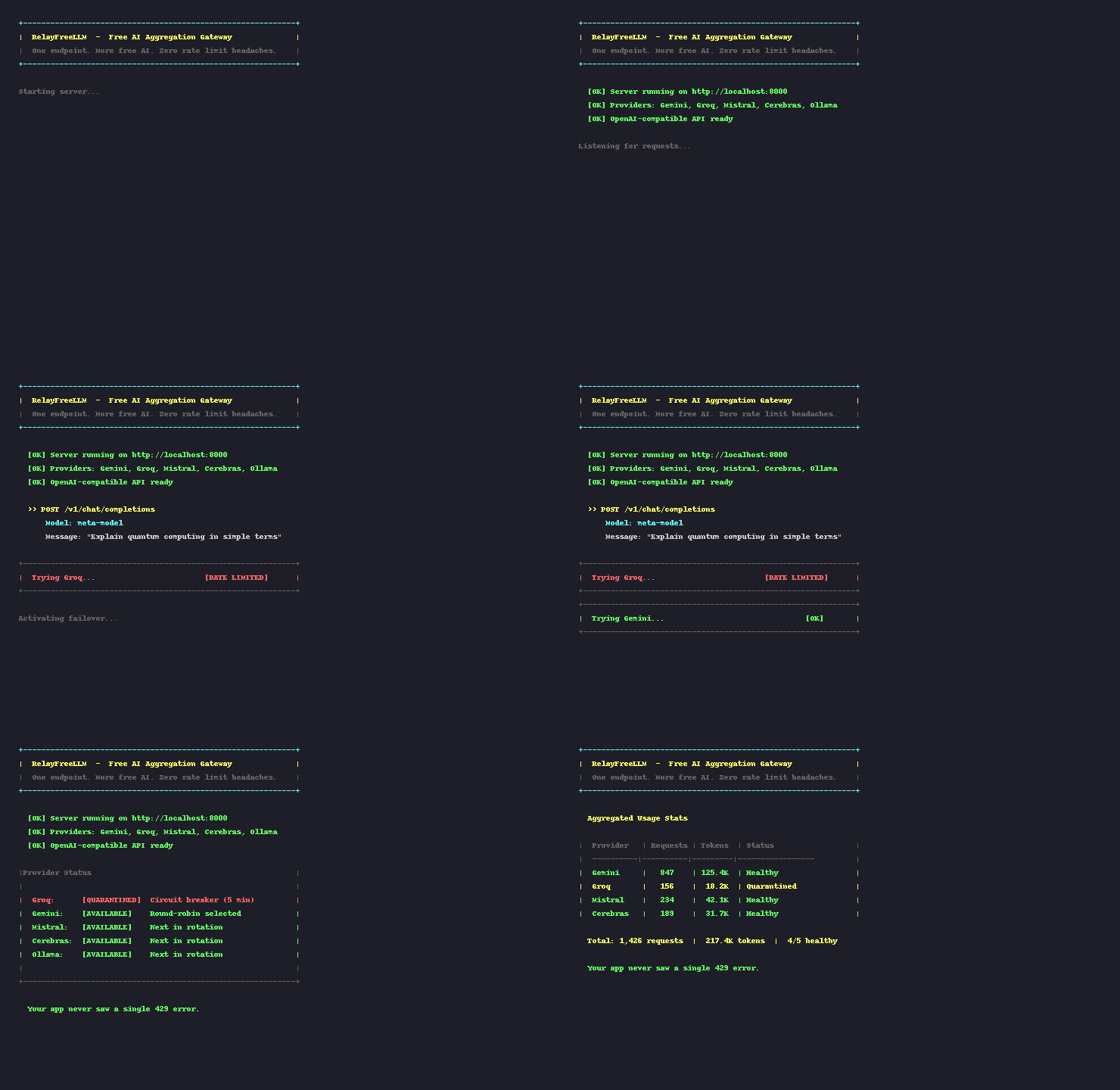
No code changes. No retry logic. No 429 errors breaking your app.
❌ Groq hits rate limit → Your app crashes       ✅ Gemini fails → Automatically tries Groq
❌ Gemini quota exhausted → User sees error       ✅ One provider down → Traffic routes to others
❌ Switching providers → Rewrite your integration  ✅ Same API for everyone → OpenAI-compatible
❌ Testing 5 providers → 5 different SDKs          ✅ More providers = More throughput
| Feature | Why It Matters |
|---|---|
| OpenAI-compatible | Drop-in for your existing code. LangChain, LlamaIndex, any SDK. |
| Automatic Failover | Provider down? One model hit limits? We try the next one automatically. Zero downtime. |
| Session Affinity | Pin conversations to a provider via X-Session-ID for context caching benefits. |
| 4-Mode Context Management | Static, Dynamic, Reservoir, Adaptive — with extractive summarization to preserve long conversations. |
| Consistent Output Style | Universal style guidance + response normalizers eliminate provider-specific quirks. Opt out per-request via X-Use-ServerSide-System-Prompt: false. |
| Intent-Based Routing | model_type=coding, model_scale=large, model_name=deepseek — tell us what you need, not which API to call. |
| [NEW] Image-aware Routing | Upload images in chat; the dispatcher automatically routes to vision-capable models. Explicit text-only model pick? Falls back within the same provider, then any provider. |
| Real-time Streaming | Full SSE streaming from every backend provider. |
| Chat UI | Built-in web chat interface at /chat — streaming, conversation history, dark/light mode, Browser or Server storage. |
| Local + Cloud | Mix your private Ollama instance with cloud free tiers seamlessly. |
| Admin Dashboard | Visual editor for provider limits and real-time usage monitoring at /admin — no manual JSON editing or server restarts. |
| User | Use Case |
|---|---|
| Independent developers | Ship AI features without a $$$/month API bill |
| Students & hobbyists | GPT-level AI, no credit card or phone number required |
| Self-hosters | Combine Ollama privacy with cloud capacity |
| Researchers | Batch queries across providers for higher throughput |
Community: 120+ GitHub stars, 10+ forks, 20+ models from 6 providers included. Active development — 70+ commits in 12 weeks.
git clone https://github.com/msmarkgu/RelayFreeLLM.git && cd RelayFreeLLM
pip install -r requirements.txtCreate a .env file in the project root folder:
GEMINI_APIKEY=      # ai.google.dev
GROQ_APIKEY=        # console.groq.com
MISTRAL_APIKEY=     # console.mistral.ai
NVIDIA_APIKEY= # build.nvidia.compython -m tests.test_models_availabilityClick to see expected output (20/20 models available)
======================================================================
MODEL AVAILABILITY SUMMARY
======================================================================
✅ PASS | Cerebras        | zai-glm-4.7                                   | Success
✅ PASS | Cerebras        | gpt-oss-120b                                  | Success
✅ PASS | Cerebras        | gemma-4-31b                                   | Success
✅ PASS | Groq            | llama-3.3-70b-versatile                       | Success
✅ PASS | Groq            | qwen/qwen3.6-27b                              | Success
✅ PASS | Groq            | openai/gpt-oss-120b                           | Success
✅ PASS | Groq            | openai/gpt-oss-20b                            | Success
✅ PASS | Groq            | openai/gpt-oss-safeguard-20b                  | Success
✅ PASS | Groq            | groq/compound                                 | Success
✅ PASS | Mistral         | mistral-large-latest                          | Success
✅ PASS | Mistral         | mistral-medium-latest                         | Success
✅ PASS | Mistral         | codestral-latest                              | Success
✅ PASS | Mistral         | mistral-large-2512                            | Success
✅ PASS | Mistral         | mistral-medium-2508                           | Success
✅ PASS | Mistral         | mistral-medium-2505                           | Success
✅ PASS | Mistral         | mistral-medium                                | Success
✅ PASS | Mistral         | codestral-2508                                | Success
✅ PASS | Gemini          | gemini-2.5-flash                              | Success
✅ PASS | Nvidia          | minimaxai/minimax-m3                          | Success
✅ PASS | Nvidia          | stepfun-ai/step-3.7-flash                     | Success
======================================================================
TOTAL: 20/20 models available.
======================================================================
python -m src.serverBuild and run the minimal Docker image from the project root:
docker build -t relayfreellm .Run the container with your .env file mounted so API keys and provider config are available:
docker run --rm --env-file .env -p 8000:8000 relayfreellmOnce the server is running, open http://localhost:8000/admin in your browser to manage rate limits, add/remove models, and monitor usage in real time.
Open http://localhost:8000/chat to start chatting — streaming responses, persistent conversation history, dark/light mode, and direct access to all providers.
from openai import OpenAI

client = OpenAI(base_url="http://localhost:8000/v1", api_key="relay-free")
response = client.chat.completions.create(
    model="meta-model",
    messages=[{"role": "user", "content": "Hello!"}]
)
Or route to a specific provider:
response = client.chat.completions.create(
    model="groq/llama-3.3-70b-versatile",
    messages=[{"role": "user", "content": "Hello!"}]
)Manage everything from your browser. The admin dashboard at http://localhost:8000/admin provides a visual interface for managing provider model limits and viewing real-time usage statistics — no need to edit JSON files by hand or restart the server.
- Providers are displayed as collapsible cards, each showing its models in an editable table.
- Edit any field inline: model name, type (text/coding/image/etc.), scale (large/medium/small), max context length, and all 7 rate-limit values (requests/tokens per second/minute/hour/day).
- Add/remove models per provider, or add/remove entire providers.
- Save writes your changes to
provider_model_limits.jsonand hot-reloads the rate-limit tracker — no server restart required.
- Summary cards show total requests, prompt tokens, completion tokens, and total tokens across all providers.
- Per-provider breakdown tables list each model's individual usage.
- Reset Stats zeros out all counters in
usage_stats.jsonwith a confirmation prompt. - Data auto-refreshes every 30 seconds.
All data is stored in JSON files — no database required.
A full-featured web chat UI ships with the server at /chat.
- Streaming responses — real-time token-by-token output
- Provider attribution — see which provider/model handled each response
- Conversation history — persist chats in your browser (
localStorage) or on the server (opt-in) - Conversation management — sidebar with search, rename, copy, delete
- Edit & delete messages — fix typos or prune unwanted branches mid-conversation
- Image upload — file picker, paste, drag-and-drop; images rendered inline in message bubbles (click to expand)
- Intent-based routing — switch models via the dropdown (
meta-modelor specificProvider/Model) - Dark/light mode — toggle in the header, preference saved
By default, conversations are saved to your browser's localStorage. Switch to Server storage via the header dropdown to persist conversations to conversations.json on disk — survives browser resets and is accessible across devices sharing the same device ID.
{"model": "meta-model"}                              // Any provider, picks the next available
{"model": "meta-model", "model_type": "coding"}      // Any coding model
{"model": "meta-model", "model_scale": "large"}       // Only large models
{"model": "meta-model", "model_name": "deepseek"}     // Prefer DeepSeek models
{"model": "Gemini/gemini-2.5-flash"} // Specific provider/modelRequest → Groq (rate limited)
→ Circuit breaker activates (60s cooldown)
→ Retry → Gemini
→ Retry → Mistral
→ Success ✓
When a user message contains image_url content parts (as defined by the OpenAI Chat Completions spec), the dispatcher automatically restricts model selection to vision-capable models:
- Meta-model routing — only models with
modality: "vision"in the registry are considered during provider/model selection. - Specific routing — if the user explicitly requests a text-only model (e.g.
nvidia/minimaxai/minimax-m2.7), the dispatcher first searches for a vision model within the same provider (e.g.nvidia/moonshotai/kimi-k2.6), then falls back to any provider's vision model. If none are available, a clear error is returned.
This behavior is driven by the per-model modality field in provider_model_limits.json. Models without image support remain available for text-only requests.
Despite switching between providers, every response is homogenized:
- Style directive injection — universal guide added to every system prompt
- Response normalization — strips "As an AI...", "Certainly!", fixes JSON, standardizes markdown
The standard system prompt injection can be disabled per-request by sending the header X-Use-ServerSide-System-Prompt: false. See Agent Framework Support below.
Pass X-Session-ID: user-123 and the gateway pins that user to a single provider. If that provider fails, the session automatically migrates.
Agent frameworks (LangChain, AutoGen, CrewAI) manage their own system prompt and conversation history. To prevent the gateway from injecting its standard prompt or reconstructing the message array, send the header:
X-Use-ServerSide-System-Prompt: false
Behaviour when false (either per-request header or server settings.json default):
- The client's
messagesarray is forwarded verbatim, preserving message order and roles (includingtoolandfunctionroles in the future). - No server-side
STANDARD_SYSTEM_PROMPTor style directive is injected. - The client's own system message (if any) is used without augmentation.
- If the client sent no system message, no system message is sent to the provider.
Set the server-wide default in settings.json:
{
  "routing": {
    "use_server_side_system_prompt": false
  }
}
Note: For full client-order fidelity, pair this with
CONTEXT_MANAGEMENT_MODE=staticinsettings.json— modes likereservoirandadaptivemay still reorder or summarise context when the conversation exceeds the token budget.
| Mode | Behavior |
|---|---|
| Static | Keeps the last N messages verbatim. |
| Dynamic | Adjusts context window based on real-time token usage. |
| Reservoir | Recent messages verbatim + extractive summary of older history. |
| Adaptive | Detects coding vs chat conversations and switches strategy. |
The Reservoir mode uses a TF-scoring algorithm to identify the most informative sentences, applies position bias for topicality, and greedily selects segments to fit your token budget — no LLM calls needed.
| Parameter | Type | Description |
|---|---|---|
model |
string | "meta-model" for auto-routing, or "provider/model" for direct |
messages |
array | Standard OpenAI message format. content accepts str or list[{type, text, ...}] for multi-modal messages. |
stream |
bool | Enable SSE streaming |
model_type |
string | Filter: text, coding, image, speech, embedding, moderation, ocr |
model_scale |
string | Filter: large, medium, small |
model_name |
string | Match model name substring |
curl http://localhost:8000/v1/models?type=coding&scale=largeMulti-modal content: The
contentfield in each message accepts either a plain string or a list of content parts (e.g.[{"type": "text", "text": "..."}, {"type": "image_url", "url": "..."}]), matching the OpenAI Chat Completions spec. When image parts are present, the dispatcher automatically routes to vision-capable models only (see Image-Aware Routing). Text parts are flattened before being sent to providers that don't support structured content.Agent frameworks: To send the client's
messagesarray verbatim without server-side system prompt injection, setX-Use-ServerSide-System-Prompt: false. See Agent Framework Support.
curl http://localhost:8000/v1/usage| Method | Endpoint | Description |
|---|---|---|
GET |
/admin |
Admin dashboard UI |
GET |
/admin/api/limits |
Get current provider model limits |
PUT |
/admin/api/limits |
Update and persist limits (hot-reloaded immediately) |
GET |
/admin/api/usage |
Get usage statistics |
POST |
/admin/api/usage/reset |
Reset usage stats to zero |
chat.py — A terminal chatbot that uses RelayFreeLLM with session persistence:
from openai import OpenAI
import readline

client = OpenAI(base_url="http://localhost:8000/v1", api_key="relay-free")
history = []

while True:
    user = input("\n> ")
    history.append({"role": "user", "content": user})
    r = client.chat.completions.create(model="meta-model", messages=history)
    reply = r.choices[0].message.content
    print(reply)
    history.append({"role": "assistant", "content": reply})
Run it. No API bill. No rate limits. That's the point.
vision.py — Send an image; the dispatcher automatically routes to a vision-capable model:
import base64
from openai import OpenAI

client = OpenAI(base_url="http://localhost:8000/v1", api_key="relay-free")

with open("photo.jpg", "rb") as f:
    b64 = base64.b64encode(f.read()).decode("utf-8")

response = client.chat.completions.create(
    model="meta-model",
    messages=[{
        "role": "user",
        "content": [
            {"type": "text", "text": "What's in this image?"},
            {"type": "image_url", "image_url": {"url": f"data:image/jpeg;base64,{b64}"}}
        ]
    }]
)
print(response.choices[0].message.content)
Run both. No API bill. No rate limits.
Default rate limits in provider_model_limits.json work for most use cases. If you hit provider caps, adjust the limits for your account tier — either by editing the file directly or using the Admin Dashboard (http://localhost:8000/admin):
Click to see example with all fields
{
  "providers": [
    {
      "name": "Groq",
      "models": [
        {
          "name": "llama-3.3-70b-versatile",
          "type": "text",
          "scale": "large",
          "limits": {
            "requests_per_second": 1,
            "requests_per_minute": 30,
            "requests_per_hour": 1800,
            "requests_per_day": 1000,
            "tokens_per_minute": 12000,
            "tokens_per_hour": 30000,
            "tokens_per_day": 100000
          },
          "Max_Context_Length": 131000,
          "modality": "text"
        },
        {
          "name": "meta-llama/llama-4-scout-17b-16e-instruct",
          "type": "text",
          "scale": "large",
          "limits": {
            "requests_per_second": 1,
            "requests_per_minute": 30,
            "requests_per_hour": 1800,
            "requests_per_day": 1000,
            "tokens_per_minute": 12000,
            "tokens_per_hour": 30000,
            "tokens_per_day": 100000
          },
          "Max_Context_Length": 128000,
          "modality": "vision"
        }
      ]
    }
  ]
}Click to expand
        ┌─────────────────────────────────────────────────┐
        │                 Your Application                │
        └─────────────────────┬───────────────────────────┘
                              │ OpenAI-compatible API
        ┌─────────────────────▼───────────────────────────┐
        │              RelayFreeLLM Gateway               │
        │  ┌───────────┐    ┌───────────┐    ┌──────────┐ │
        │  │  Router   │───▶│Dispatcher │───▶│ContextMgr│ │
        │  │ /v1/chat  │    │ (Retries) │    │(Summary) │ │
        │  └───────────┘    └─────┬─────┘    └──────────┘ │
        │                         │          ┌──────────┐ │
        │                         └─────────▶│Affinity  │ │
        │                                    │  Map     │ │
        │                                    └──────────┘ │
        └─────────────────────────┬───────────────────────┘
                                  │
      ┌──────────┬──────────┬─────┴────┬──────────┬──────────┬──────────┐
      ▼          ▼          ▼          ▼          ▼          ▼          ▼
 ┌────────┐ ┌────────┐ ┌────────┐ ┌────────┐ ┌────────┐ ┌────────┐ ┌────────┐
 │ Gemini │ │  Groq  │ │ Mistral│ │Cerebras│ │DeepSeek│ │ Ollama │ │ NVIDIA │
 └────────┘ └────────┘ └────────┘ └────────┘ └────────┘ └────────┘ └────────┘
- Web dashboard for live provider status
- Persistent rate limit state (survives restarts)
- Prompt caching layer
- Image upload routing (vision models)
- Embeddings & image generation routing
- One-command Docker deploy
Found a new free provider? Adding one takes ~50 lines:
# src/api_clients/my_provider_client.py
class MyProviderClient(ApiInterface):
    PROVIDER_NAME = "myprovider"

    async def call_model_api(self, request, stream):
        # Your API logic here
        pass
PRs welcome.
Built with FastAPI, Pydantic, httpx, and AI coding tools.
Powered by the generous free tiers of Google Gemini, Groq, Mistral AI, Cerebras, NVIDIA, DeepSeek, Cloudflare, and Ollama.
Built for developers who want great AI without the bill.