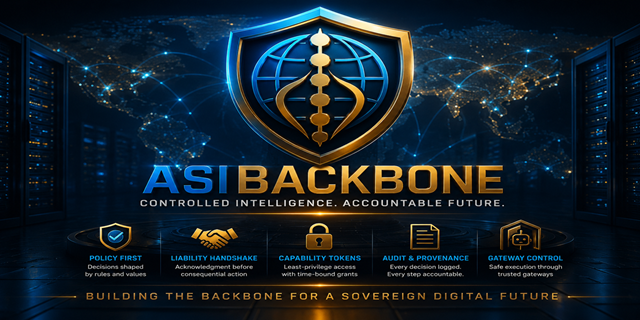









Accountable Systems Infrastructure for governed .NET decision flow.
AI may provide the intellect. AsiBackbone provides the accountable spine.
AsiBackbone/AsiBackbone is the source of truth for the concrete product: package installation and configuration, public APIs and type behavior, runtime semantics, integration boundaries, security posture, operations, compatibility, releases, and maintainer evidence.
For organization-level concepts, architecture education, terminology lineage, tutorials, comparisons, tradeoffs, labs, and general governed-execution teaching, use ASI Backbone Learning and its source repository as the canonical educational source. Learning does not define or override released AsiBackbone package, API, configuration, or runtime behavior.
See the cross-repository documentation ownership contract for the full routing matrix.
Most software can tell you what happened. Far less can show that an action was evaluated before it executed: which rules shaped the decision, which policy version applied, whether acknowledgment was required, how follow-on authority was scoped, and where the host took responsibility for execution.
AsiBackbone is a .NET package family for that decision boundary. It helps a host application build safe policy context, evaluate constraints, return a structured decision, preserve a decision receipt, optionally scope continuation, and then let the host decide whether and how to execute.
In this software project, ASI means Accountable Systems Infrastructure.
A normal API adoption path looks like this:
HTTP request
  -> host builds safe evaluation context
  -> host-owned rules evaluate the request
  -> AsiBackbone returns a GovernanceDecision
  -> host writes audit residue / decision receipt
  -> host continues only when decision.CanProceed is true
Use plain engineering translations first:
| Project term | Practical meaning |
|---|---|
| Governance spine | Policy decision pipeline around consequential operations. |
| Audit residue | Decision receipt or audit-log payload. |
| Acknowledgment handshake | Confirmation workflow before a risky operation. |
| Capability grant | Short-lived scoped permission. |
| Governance outbox | Durable outbox pattern for governance events. |
| OpenTelemetry projection | Optional traces/metrics projection after local records exist. |
| Host-owned execution boundary | The application code that performs or refuses the protected operation. |
The snippet below is an intentionally small README slice, not a complete Program.cs. It shows the primary governance path: build safe context, evaluate policy, write audit residue, and let the host execute only after the decision allows it. The full compile-ready walkthrough lives in First 15 Minutes: Standard API Gating.
// Registration: Core evaluator + one host-owned rule + local in-memory audit sink.
builder.Services.AddAsiBackboneAspNetCore();
builder.Services.AddSingleton<InMemoryAuditLedger>();
builder.Services.AddSingleton<IAsiBackboneAuditSink>(sp =>
    sp.GetRequiredService<InMemoryAuditLedger>());
builder.Services.AddSingleton<IAsiBackboneConstraint<AsiBackboneConstraintEvaluationContext>, AllowedRegionConstraint>();
builder.Services.AddSingleton<IAsiBackbonePolicyEvaluator<AsiBackboneConstraintEvaluationContext>>(sp =>
    DefaultAsiBackbonePolicyEvaluator.CreateBuilder<AsiBackboneConstraintEvaluationContext>()
        .AddConstraints(sp.GetServices<IAsiBackboneConstraint<AsiBackboneConstraintEvaluationContext>>())
        .WithOptions(new AsiBackbonePolicyEvaluatorOptions())
        .Build());

app.MapPost("/api/orders/{region}/approve", async (
    string region,
    HttpContext httpContext,
    IAsiBackbonePolicyEvaluator<AsiBackboneConstraintEvaluationContext> evaluator,
    IAsiBackboneAuditSink auditSink,
    CancellationToken cancellationToken) =>
{
    var metadata = new Dictionary<string, string>(StringComparer.Ordinal)
    {
        ["operation"] = "orders.approve",
        ["region"] = region,
        ["risk"] = "routine-api-write"
    };

    var context = new AsiBackboneConstraintEvaluationContext(
        correlationId: httpContext.TraceIdentifier,
        policyVersion: "policy-v1",
        policyHash: "policy-hash-v1",
        metadata: metadata);

    GovernanceDecision decision = await evaluator.EvaluateAsync(context, cancellationToken);

    AuditResidue residue = AuditResidue.FromDecision(
        AsiBackboneActorContext.Human("example-user", "Example User"),
        operationName: "orders.approve",
        decision,
        metadata: context.Metadata);

    await auditSink.WriteAsync(residue, cancellationToken);
    if (!decision.CanProceed)
    {
        return Results.Json(new
        {
            allowed = false,
            decision = decision.Outcome.ToString(),
            decision.ReasonCodes,
            auditEventId = residue.EventId
        }, statusCode: StatusCodes.Status403Forbidden);
    }

    // Host-owned execution starts here. AsiBackbone does not approve the order itself.
    return Results.Ok(new
    {
        allowed = true,
        message = "Host order approval would run after this governance decision.",
        auditEventId = residue.EventId
    });
});
The 4.x evaluator defaults are intentionally fail-closed for governed surfaces: empty policy structures deny, eligible ordinary constraint exceptions deny with asibackbone.policy.constraint_exception, and threat-contributor exceptions deny. Set TreatConstraintExceptionAsDenial = false only when a host intentionally wants fail-fast exception propagation through its own exception, transaction, retry, telemetry, or incident-response boundary.
For production-style hosts, add durable audit/outbox persistence, signing or verification, DLP/classification, provider emission, and operational monitoring only where the host has explicitly chosen and configured those boundaries.
Stable 5.2.x package family. 5.2.0 is the current release. It is a
backward-compatible minor release that adds the fluent policy-evaluator builder,
starts the ASIB900 deprecation window for partial evaluator constructors, and
strengthens package compatibility, durable release evidence, quality gates, and
project stewardship. Package IDs, public namespaces, the net10.0 target, and
the binary assembly identity 5.0.0.0 remain unchanged.
Consumers upgrading from 4.0.0 should review the 5.0.0 migration guide; hosts that persist the affected enums as integers need a data migration.
| Package | Role |
|---|---|
AsiBackbone.Core |
Framework-neutral governance primitives: decisions, constraints, threat-model contributor hooks, acknowledgments, audit residue, lifecycle events, governed execution receipts, capability-token abstractions, explicit capability-grant validation profiles and proof trust pinning, durable outbox contracts, provider-neutral emission contracts, DLP/classification policy primitives, signing-ready metadata, canonical hashing/signing seams, verification-policy primitives, policy evaluator options, metadata budget helpers, and builder-style audit residue construction. |
AsiBackbone.DependencyInjection |
Explicit AddAsiBackbone(...) builder facade for coordinating host-selected provider registrations without making Core own infrastructure. |
AsiBackbone.Storage.InMemory |
Non-durable in-memory storage helpers for tests, samples, local validation, lifecycle events, and outbox proof paths. |
AsiBackbone.EntityFrameworkCore |
EF Core model configuration and host-owned persistence for audit ledger, acknowledgments, lifecycle events, JSON metadata storage, and governance outbox records. |
AsiBackbone.AspNetCore |
ASP.NET Core host adapters for actor context, conservative actor-type claim mapping, request correlation, audit enrichment, HTTP result mapping, acknowledgment challenge flows, endpoint governance, endpoint metadata mode, strict-governance profile helpers, endpoint fast-abort metadata, and hosted outbox drain integration. |
AsiBackbone.Testing |
Test-only harness helpers for deterministic endpoint governance, policy results, capability validation, in-memory audit inspection, non-durable outbox storage, and no-signature signing seams. |
AsiBackbone.Templates |
dotnet new templates for generating governed ASP.NET Core host scaffolds with endpoint governance, sample policies, local in-memory audit inspection, analyzers, and README guidance. |
AsiBackbone.Analyzers |
Roslyn analyzer safety rails for governance persistence and continuation flows. |
AsiBackbone.OpenTelemetry |
Released OpenTelemetry governance emission provider that projects provider-neutral envelopes into .NET diagnostics. |
AsiBackbone.Signing.LocalDevelopment |
Local-development signing and verification for tests, samples, and wiring proof paths only. Not for production key custody. |
AsiBackbone.Signing.ManagedKey |
Provider-neutral managed-key signing adapter boundary. The host supplies the actual managed-key client, credentials, key operations, verification path, monitoring, and operational policy. Production-oriented registration fails closed by default when signing cannot complete. |
Runtime governance-residue signing remains provider-neutral through AsiBackbone.Signing.ManagedKey. AsiBackbone does not ship first-party Azure Key Vault, AWS KMS, GCP Cloud KMS, HSM, certificate-store, enterprise KMS, or production-style signing sample-host implementations. Future Event Hubs, Purview, gateway, robotics, immutable-storage, or other non-signing provider packages are not part of the stable contract unless separately reviewed and released.
Stable 5.x packages intentionally target net10.0. Consumers should plan on a .NET 10 SDK/runtime or later for the current package line.
The project is not multi-targeting .NET 8 for 5.x. That is an explicit adoption decision, not a defect workaround. The current package family uses a single repository-wide TargetFramework of net10.0, the EF Core integration is aligned with centrally managed EF Core 10.0.x dependencies, and backporting the full package, analyzer, template, CI, packaging, and smoke-test surface would add compatibility overhead for a short-lived adoption window.
If meaningful external consumer demand appears, additional TFM support can be reconsidered in a later release with CI, packaging validation, analyzer compatibility, template smoke tests, and documentation updated together. See the Target Framework Support Decision Record.
Use the organization as one connected path; each repository has a distinct job:
- Learn the pattern: start with ASI Backbone Learning for concepts, tutorials, labs, comparisons, and adoption personas.
- Try a complete host: use NetCoreApplicationTemplate when you want a production-oriented ASP.NET Core baseline to evaluate or adapt.
- Adopt the packages: return here for the
implementation-first path,
install only the
AsiBackbone.*packages your host needs, and validate one low-risk governed operation before expanding.
Already evaluating or using the project? See the public adopter registry and use its report form to share permission-based adoption evidence or feedback.
For implementation-first adoption:
- Implementation-First Adoption Path — plain engineering translations and the recommended first reading path.
- First 15 Minutes: Standard API Gating
- AddAsiBackbone Builder Facade
- dotnet new Templates
- Target Framework Support Decision Record
- Reference Deployment: Plain ASP.NET Core Host Evidence
- Testing Harness
- Strict Governance Profile
- Threat Model Contributors
- Project Boundaries and Non-Claims
- Terminology Map
- Progressive Adoption Ladder
- Production Managed-Key Integration Guide
For optional conceptual background:
- Intent to Execution: An Accountability Pattern
- Core Governance Flow Diagrams
- ASI Backbone Concept Synopsis
- Dynamic Liability Handshake
- Core Domain Language
- Host-Owned Execution Enforcement
The full, categorized documentation set lives at the documentation site.
Stable 5.x is the current released line, with 5.2.0 as the current release. Package IDs and public namespaces remain unchanged, and the binary assembly identity is 5.0.0.0.
The stable API contract is documented in API Compatibility and SemVer. The current release is recorded in 5.2.0 Release Notes. Consumers can use the 5.2.0 Consumer Verification Guide for package-source, API-compatibility, Source Link, SBOM, provenance, deprecation, and deferred-signing checks. Consumers moving from 4.x should also follow the 5.0.0 Migration Guide. Earlier release records remain available for historical traceability.
- Use the Support Policy to choose between discussions, issues, and private vulnerability reporting and to review the version-support lifecycle.
- Report sensitive concerns through the repository Security Policy.
- See Maintainers for current operational and publishing ownership.
- See Governance for authoritative roles, decisions, triage, and release policy.
- See Adopters for public adoption evidence and the opt-in reporting path.
NetCoreApplicationTemplate may be used as a preferred host baseline during development and validation, but AsiBackbone does not require it.
NetCoreApplicationTemplate = preferred host baseline
AsiBackbone               = optional governance/module package family
Consumer application      = chooses whether to use either or both
A consumer should be able to use AsiBackbone in an application generated from NetCoreApplicationTemplate, in an existing ASP.NET Core application, or in a custom host that provides the required infrastructure. See NetCoreApplicationTemplate Host Validation.
AsiBackbone is a governance spine, not an intelligence engine. It implements governance-oriented software primitives for accountable decision flow and keeps execution authority with the host application. See Project Boundaries and Non-Claims for the full scope statement and safe wording guidance.
Current NuGet packages are intentionally published without package signing. The dated NuGet Package Signing Decision Record records the accepted risk, compensating controls, mandatory review date, and early re-evaluation criteria. The project publishes durable release-attached SBOMs, package/SBOM provenance, Source Link metadata, and package hashes as distinct trust signals; none is presented as a signed-package guarantee. For current verification guidance, see the 5.2.0 Release Notes and the 5.2.0 Consumer Verification Guide.
- Keep Core small.
- Keep Core dependency-light.
- Avoid hidden host assumptions.
- Prefer explicit integration over magic.
- Let the host own infrastructure.